 |
| The truck undergoing its re-finishing. |
Tuesday, July 19, 2011
A Shiny Truck Finish that Costs Only Pennies!

Sunday, July 10, 2011
Running the Mighty Arkansas
Record snowmelt in the Rockies has pushed many of rivers in the West to record high levels. The Arkansas River, which originates near Leadville, Colorado, and runs east through Colorado, Kansas, Oklahoma, and Arkansas, before joining the Mississippi River, is no exception. In fact, the most popular whitewater rafting section of the Arkansas, the Royal Gorge near Canon City, Colorado, was closed for 23 days due to unsafe high water conditions. It just so happened that the river dipped below the unsafe threshold on the day we had reserved to raft the Gorge. Paula and I have rafted whitewater on numerous occasions, but the first section of the Royal Gorge on this trip was the most intense and challenging single stretch we have encountered -- and that includes the Colorado River through the Grand Canyon. And the fact we were able to run the Gorge with my niece and nephew, and our friends Mike and Heather, made it a special day.
 |
| Your humble blogger in the front left seat getting ready to swallow a mouthful of ice cold Arkansas River water. |
A Western Road Hazard -- Falling Cows!
I thought someone was playing a joke when we came across this road sign in the town of Red River. But it is an official New Mexico DOT sign erected to warn motorists that, in addition to rocks, cows could fall onto the road from the hills above. The hillside slopes are free-range grazed and some are quite steep. After rains they get really slick as well. In some states, cows have fallen directly onto cars. The more frequent occurrence is when cows slip off the hillside and fall onto the road injuring themselves, and cars run into them.
 |
| I'm not sure what a motorist is to do if a cow comes falling out of the sky. |
A Train Ride into the Clouds
 |
| The spectacular view from the summit of Pike's Peak. |
 |
| The awe-inspiring view from Pike's Peak was the inspiration for Katherine Lee Bates to compose "America the Beautiful." |
The Yodeling Waitress
 |
| Liz Masterson, our server, whose voice caused an avalanche -- or did it? |
 |
| The White Fence Farm has been serving fried chicken dinners in Lakewood, Colorado, since 1973. |
A few posts back (Sweetheart of the Rodeo), I mentioned how you never know when you are in the presence of a celebrity. On our brief pass through the Denver area, we ran into another celebrity while having a great fried chicken dinner at the White Fence Farm. Liz Masterson was our server and she did a wonderful job, but it seems her talents lie in other areas. Liz also performs western and swing music in Denver and was featured on an episode of "Mythbusters" during the 2007 season. Seems she is quite a yodeler as well as a musician and the show needed someone to test a theory that yodeling could trigger an avalanche. You can check out the episode on YouTube to see if Liz was able to dislodge the snow from the mountain.
Saturday, July 9, 2011
Geysers, Mudpots, Hot Springs, and Fumaroles
 |
| A roiling mudpot just north of the Lake area. |
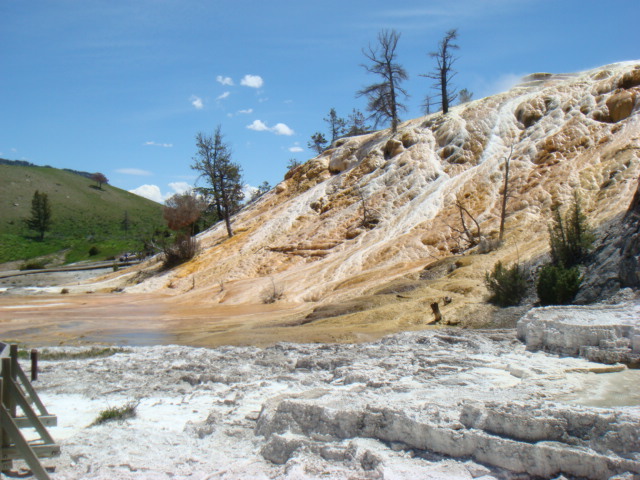 |
| The magnificent travertine terraces at Mammoth Hot Springs. |
 |
| The most famous geothermal feature in Yellowstone -- Old Faithful. |
Springtime in Yellowstone?
 |
| Springtime Yellowstone --Arrowleaf bitteroot along the Blacktail Deer Creek Trail |
 |
| Winter Yellowstone -- Paula navigating the snowbanks along the Howard Eaton Trail. |
Subscribe to:
Posts (Atom)